
GlycoPulse Ingredients: What Is on the Label? 7 Checks
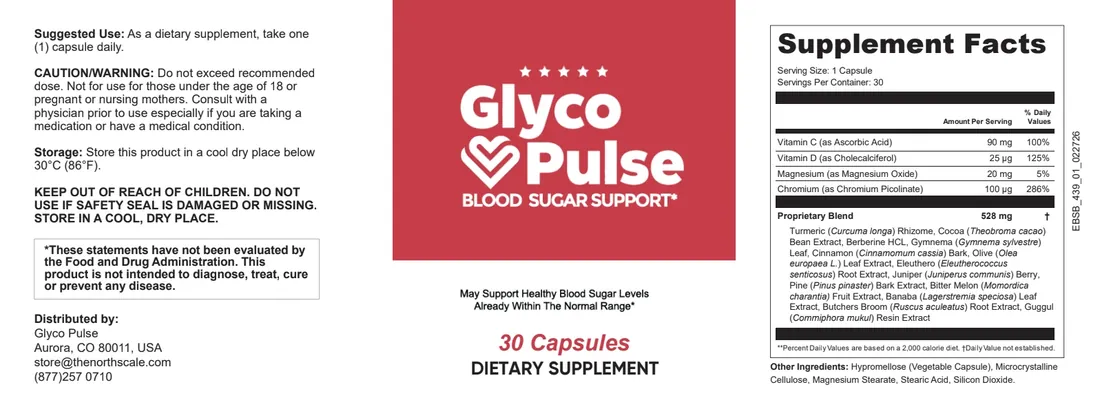
Each Glyco Pulse capsule lists vitamin C 90 mg, vitamin D 25 mcg, magnesium 20 mg, chromium 100 mcg and a 528 mg proprietary blend of 13 herbs. The amount of each herb, including berberine, is not published. Use seven label checks to read the panel and compare it with study doses.
Key facts
- Serving: 1 capsule. Servings per bottle: 30.
- Printed amounts: vitamin C 90 mg (100% DV), vitamin D 25 mcg (125% DV), magnesium 20 mg (5% DV), chromium 100 mcg (286% DV).
- Proprietary blend: 528 mg for 13 herbs. The split between herbs is not published.
- The label lists 17 active ingredients and five other ingredients.
- A simple average is about 41 mg per herb (528 divided by 13). It is a guide, not a label figure.
- No batch has an independent lab certificate on public record.
Check 1: What are the serving and the form?
Start with what one unit is.
Before ingredients, read the top of the panel. The serving size is 1 capsule. There are 30 servings per container. So one bottle is a 30-day supply at the label dose.
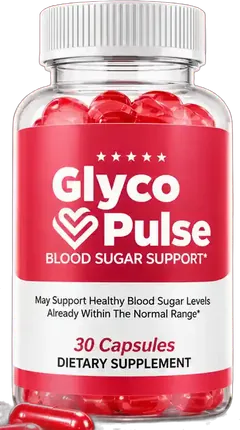
The form is a capsule. The shell is hypromellose, a vegetable capsule. People who search glycopulse pills, glycopulse tablets or glycopulse drops will find the same answer: this label is a capsule. A gummy or a liquid with a similar name is a different product.
Check 2: Which four ingredients have real amounts?
These are the numbers you can compare with your other pills.
Printed amounts per capsule (label)
| Nutrient (label form) | Per capsule | % Daily Value | Plain context |
|---|---|---|---|
| Vitamin C (ascorbic acid) | 90 mg | 100% | Same as the Daily Value; the upper limit is 2,000 mg (NIH ODS, Vitamin C) |
| Vitamin D (cholecalciferol) | 25 mcg | 125% | A quarter of the 100 mcg upper limit (NIH ODS, Vitamin D) |
| Magnesium (magnesium oxide) | 20 mg | 5% | Small; diabetes trials used 300 to 600 mg (NIH ODS, Magnesium, 2026) |
| Chromium (chromium picolinate) | 100 mcg | 286% | Low end of the 100 to 1,000 mcg trial range (NIH ODS, Chromium) |
The percent figures come from simple division. Chromium shows it best: 100 mcg divided by a 35 mcg Daily Value is about 286%. If you also take a multivitamin, add its vitamin D and chromium to these numbers. Of the four, vitamin D is the one to tally carefully.
Check 3: What are the 13 herbs, and in what order?
The order on the label is a clue.
The blend line names 13 herbs. Here they are in label order: turmeric rhizome, cocoa bean extract, berberine HCl, gymnema leaf, cassia cinnamon bark, olive leaf extract, eleuthero root extract, juniper berry, pine bark extract, bitter melon fruit extract, banaba leaf extract, butcher's broom root extract and guggul resin extract.
A proprietary blend is listed from the largest share to the smallest. So turmeric is the biggest share and guggul the smallest, even though no milligrams are printed. That order lets you set ceilings, but not real amounts.
- Berberine is third, so it cannot weigh more than about 176 mg (528 divided by 3).
- Gymnema is fourth, so at most about 132 mg.
- Cinnamon is fifth, which caps it near 106 mg.
Treat these as ceilings, not as guesses at the real figures. Real shares are probably lower for the later herbs.
Check 4: How do those ceilings compare with study doses?
Studies used much more than the blend can hold.
Now set the ceilings beside the doses used in research. Trials of berberine HCl usually used 500 mg twice a day, about 1,000 mg daily (Liang et al., 2019 (berberine meta-analysis)). Gymnema is typically taken at about 400 mg three times a day. Cinnamon trials ranged from 120 mg to 6 g a day (Allen et al., 2013 (cinnamon meta-analysis)).
Research doses against the most the label order allows
| Herb | Study or typical dose | Most the blend could hold |
|---|---|---|
| Berberine | About 1,000 mg a day | About 176 mg |
| Gymnema | About 1,200 mg a day | About 132 mg |
| Cinnamon | 120 mg to 6 g a day | About 106 mg |
This does not prove the capsule is weak. Smaller amounts might still matter to some people. It does mean single-herb trials cannot predict what this blend does. The finished formula has not been studied.
Compare the label with your own bottle
Every figure in this article comes from the bottle label. The order page shows the packs and the guarantee terms.
This site earns money when you buy through it.
Check 5: What are the other ingredients?
Capsule helpers, not the active part.
The label lists five other ingredients: hypromellose, microcrystalline cellulose, magnesium stearate, stearic acid and silicon dioxide. They help form the capsule and keep the powder flowing. None is the part that is meant to do the work.
An allergen statement does not appear in the label text we have, so if you have allergies, read the bottle itself and ask the order desk at +1 (877) 257-0710.
Check 6: Which ingredients need a safety check first?
Most people tolerate them. A few matter with medicines.
Ingredient checks to raise with your doctor or pharmacist
| Ingredient | Why it matters |
|---|---|
| Berberine, chromium, bitter melon, olive leaf | May add to insulin or diabetes pills and push blood sugar too low (NIDDK, Low blood glucose) |
| Berberine | Changes how some medicines are processed; avoid in pregnancy and breastfeeding (MSK About Herbs, Berberine, 2023) |
| Turmeric, pine bark | May add to bleeding risk with blood thinners (MSK About Herbs, Turmeric, 2026) |
| Butcher's broom | MSK lists diabetes as a do-not-take condition after a ketoacidosis report (MSK About Herbs, Butcher's broom, 2023) |
| Guggul, chromium | Thyroid lab changes and levothyroxine absorption (MSK About Herbs, Guggul, 2022) |
The label also says not for anyone under 18 or for pregnant or nursing mothers, and to consult a physician first if you take medication.
Check 7: What is not on the label?
Gaps are part of the ingredients list.
- Names of all 17 active ingredients in label orderShown
- Amounts and % Daily Value for four nutrientsShown
- Total weight of the blend: 528 mgShown
- Milligrams of each herb, including berberineNot published
- Extract strength, such as curcumin in the turmericNot published
- The manufacturer's nameNot published
- An independent lab certificateNot published
- An FDA-registered-facility or GMP statement on the labelNot on label
The lot reference GP-26/GO-2232 and the CoA reference GP-2232-26-GO help trace a run. They are not lab results. If you want proof of strength, ask the order desk for the certificate that matches the lot on your bottle.
Frequently asked questions
What does each Glyco Pulse capsule contain?
Each capsule lists vitamin C 90 mg, vitamin D 25 mcg, magnesium 20 mg, chromium 100 mcg and a 528 mg proprietary blend of 13 herbs, starting with turmeric, cocoa and berberine HCl and ending with guggul.
What is the berberine amount per capsule?
Not published. Berberine HCl sits inside the 528 mg blend, and the label does not give each herb's amount. By label order it cannot exceed about 176 mg, against about 1,000 mg a day in trials.
Is there cinnamon or gymnema in Glyco Pulse?
Yes. Cassia cinnamon bark is fifth and gymnema leaf is fourth in the blend. Neither amount is printed.
Why is the blend proprietary?
A proprietary blend lets a brand print the total weight without the amount of each herb. It protects the recipe, but buyers cannot compare each herb with research doses.
Are Glyco Pulse capsules, pills, tablets or gummies?
The label describes capsules, 30 per bottle, with a hypromellose vegetable capsule shell. A gummy or tablet with a similar name would be a different product.
What else is in the capsule besides the actives?
Hypromellose (vegetable capsule), microcrystalline cellulose, magnesium stearate, stearic acid and silicon dioxide.
Is the GlycoPulse herb blend proprietary?
Yes. The 528 mg blend of 13 herbs is listed as one total, so the amount of each herb is not published. That is why exact comparison with study doses is not possible.
How much vitamin D is in GlycoPulse?
Each capsule lists vitamin D 25 mcg. It also lists vitamin C 90 mg, magnesium 20 mg and chromium 100 mcg, plus the 528 mg herb blend.
How much vitamin C is in Glyco Pulse?
Each Glyco Pulse capsule lists vitamin C at 90 mg.
Our view
The Glyco Pulse label is clear where it gives numbers and quiet where it does not. Four nutrients are printed with amounts. Thirteen herbs share one number. That is a legal way to label a supplement, and it is also a limit on what a careful buyer can check.
We find the simple math the most useful tool here. The blend averages about 41 mg per herb, and even the most generous reading of the label order leaves berberine well under the trial dose. That does not make the capsule useless. It makes confident promises about it hard to support.
Glyco Pulse is a dietary supplement. It is not FDA approved and not a medicine. Bring the label to your doctor or pharmacist before you start, especially if you take any prescription.
A readable label, with gaps
If you want to try the capsule, the order page shows today's price and the 60-day refund terms first. Bring the label to your pharmacist.
This site earns money when you buy through it.
